How to Create a Sell Sheet: A Guide for Brands Preparing for Retail
A great product deserves a great presentation.
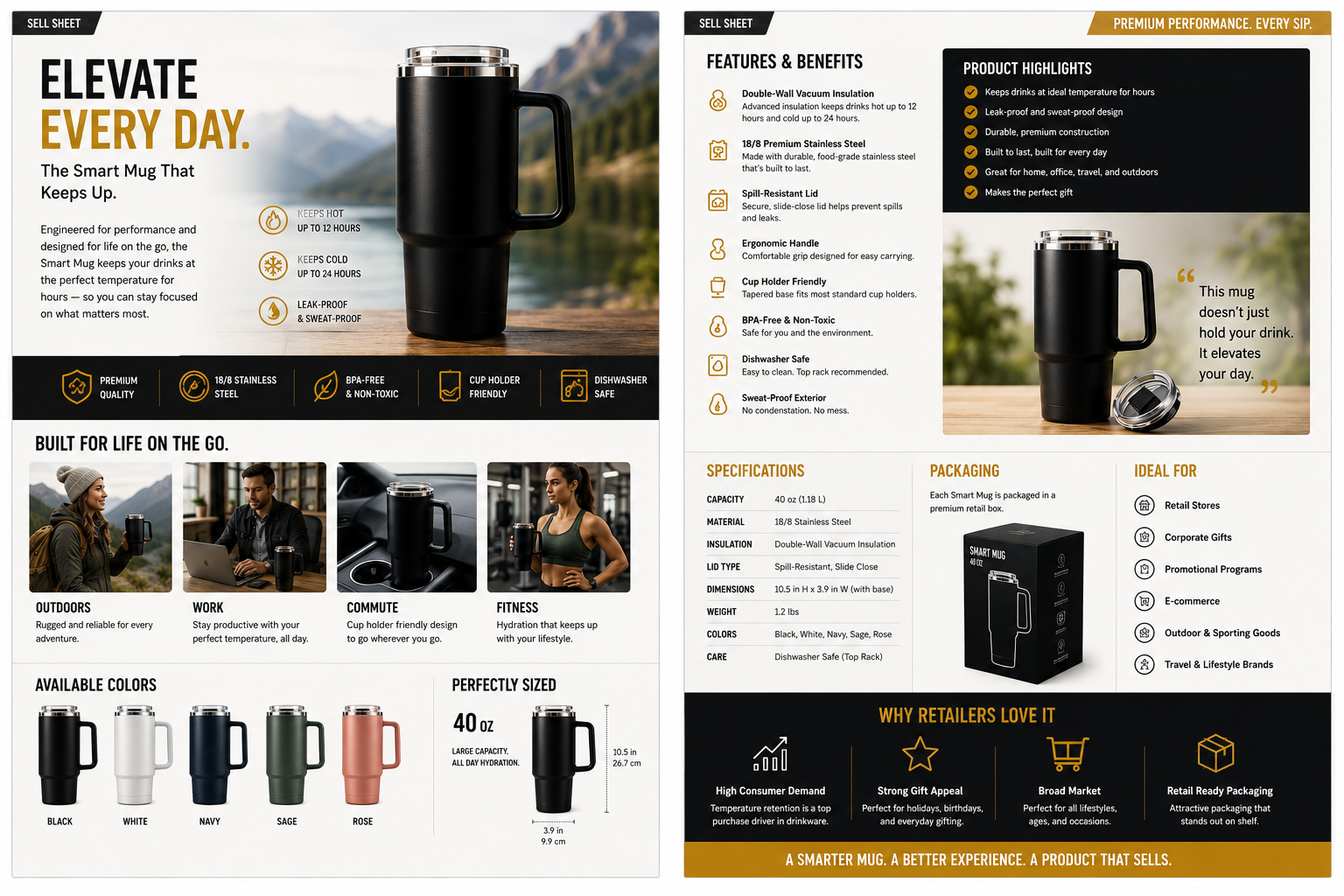
When introducing a product to a retail buyer, distributor, sales representative, or potential business partner, one of the most important sales tools you can have is a professional sell sheet.
A sell sheet is designed to communicate the value of your product quickly and clearly.
It is not a catalog.
It is not a lengthy presentation.
It is a focused sales tool designed to make someone want to learn more about your product.
What Is a Sell Sheet?
A sell sheet is a professional one- or two-page sales document that provides a concise overview of a product or product line.
The purpose of a sell sheet is to help a potential buyer quickly understand:
What the product is
What the product does
Who the product is for
Why the product is different
The key features and benefits
Important product specifications
Retail pricing information
How to learn more or place an order
Think of your sell sheet as a salesperson on paper.
In many cases, it may be one of the first materials a retail buyer sees from your company.
First impressions matter.
Keep Your Sell Sheet Focused
One of the most common mistakes brands make is trying to put too much information on a sell sheet.
More information does not always create a stronger presentation.
Retail buyers are busy.
The goal is to communicate the product opportunity quickly.
A buyer should be able to look at your sell sheet and understand the basic product story within seconds.
Ask yourself:
What is the product?
Why should a customer care?
What makes it different?
Why could it sell?
If those answers are difficult to find, the sell sheet may need to be simplified.
Start With a Strong Product Headline
The headline should immediately communicate the product or its primary value.
Avoid complicated industry terminology whenever possible.
A strong headline may focus on:
The problem the product solves
The primary consumer benefit
The product’s unique advantage
A major point of differentiation
For example:
Smarter Hydration. Wherever Life Takes You.
Professional-Grade Cleaning Made Simple.
A Better Way to Organize Your Garage.
Comfort Designed for Better Sleep.
The headline should create interest and encourage the buyer to continue reading.
Use Professional Product Photography
Product photography is one of the most important elements of a sell sheet.
The product should be clearly visible.
Whenever possible, include:
Images should be high resolution and professionally presented.
Avoid blurry images, screenshots, inconsistent backgrounds, and low-resolution photographs.
Your photography communicates the quality of your brand.
Clearly Explain the Product
Do not assume the buyer understands your product.
Include a short product description that clearly explains what the product is and what it does.
Keep the description concise.
A strong product description should answer:
What is it?
What does it do?
Who uses it?
Why is it valuable?
Avoid writing a long company history in this section.
The focus should remain on the product and the retail opportunity.
Highlight Features and Benefits
Features explain what the product has.
Benefits explain why the customer should care.
For example:
Feature: 24-hour battery life.
Benefit: Use the product throughout the day without constantly recharging.
Another example:
Feature: Waterproof construction.
Benefit: Designed for reliable use in wet or outdoor environments.
A strong sell sheet should communicate both.
Consider highlighting three to six of the product’s strongest selling points.
Keep them short and easy to scan.
Show What Makes the Product Different
Retail buyers see many products.
Your sell sheet should clearly communicate your product’s point of difference.
Ask:
Why this product?
Why this brand?
Why now?
Differentiation may include:
Do not make the buyer search for the reason your product is different.
Make it obvious.
Include Important Product Information
Depending on the product and retail channel, your sell sheet may include:
Product name
Model number
SKU
UPC or GTIN
MSRP
MAP price, when applicable
Wholesale price, when appropriate
Product dimensions
Product weight
Available colors
Case pack quantity
Master carton information
Country of origin
Not every piece of technical information needs to be on the sell sheet.
Detailed logistics and product data may be better presented on a separate Product Specification Sheet.
The sell sheet should remain visually clean and focused on selling the product.
Include Retail-Ready Packaging
If the product has retail packaging, consider showing it on the sell sheet.
Retail buyers need to understand how the product may appear in their stores or online assortment.
Packaging images can help communicate:
Brand presentation
Shelf presence
Product size
Merchandising potential
Consumer messaging
If possible, show both the product and the retail packaging.
Consider Adding a QR Code
A QR code can turn a printed sell sheet into an interactive sales tool.
The QR code may link to:
A product demonstration video
Product website
Digital sales presentation
Live shopping demonstration
Product catalog
Additional specifications
Brand story
Always test the QR code before distributing the sell sheet.
The destination should be professional, mobile-friendly, and directly related to the product.
Include Sales and Marketing Support
Retail buyers may want to understand how the brand plans to support the product.
A brief section may highlight:
Digital advertising
Social media
Influencer marketing
Public relations
Product demonstrations
Live shopping
Retail promotions
In-store displays
Video marketing
Keep this section concise.
The goal is to demonstrate that the brand has a plan to create awareness and support sell-through.
Add a Clear Call to Action
What do you want the reader to do next?
The sell sheet should include a clear next step.
Examples include:
Schedule a Product Review
Request Samples
Contact Us for Retail Opportunities
View the Product Demonstration
Learn More About the Brand
Include professional contact information.
Depending on the purpose of the sell sheet, this may include:
Company name
Website
Sales contact
Email address
Phone number
Make it easy for an interested buyer to respond.
One Page or Two Pages?
Many strong sell sheets are one page.
However, a two-page sell sheet can be effective when a product requires additional explanation or visual storytelling.
Page One should sell the opportunity.
Use strong imagery, product positioning, features, benefits, and differentiation.
Page Two should support the opportunity.
Use product details, specifications, packaging information, marketing support, and additional images.
Do not create a second page simply to add more words.
Every section should serve a purpose.
Common Sell Sheet Mistakes
Brands should avoid:
Too much text
Small fonts
Low-resolution images
Complicated product descriptions
Missing contact information
Inconsistent branding
Too many products on one page
Unclear pricing
Missing product specifications
No clear product differentiation
Poorly designed layouts
Broken QR codes
A sell sheet should look like it belongs in a professional retail presentation.
How DPG Distribution Helps Brands Prepare for Retail
At DPG Distribution, we believe professional sales materials are an important part of retail preparation.
We work with brands to help prepare and position products for retail opportunities.
Our Retail Ready process may include guidance on:
Sell sheets
Product specification sheets
Executive sales presentations
Retail packaging
Packaging layout sheets
Product photography
In-store display concepts
End-cap concepts
Pallet display concepts
Product positioning
Retail strategy
Our goal is simple:
Help brands make the best possible first impression.
Frequently Asked Questions
How many pages should a sell sheet be?
Most sell sheets are one or two pages. The document should be long enough to communicate the product opportunity while remaining easy to review.
Should a sell sheet include pricing?
It depends on the audience and purpose of the document. MSRP, MAP pricing, and wholesale information may be included when appropriate. Some brands maintain different versions of sell sheets for different audiences.
Should every product have its own sell sheet?
For major products or product families, individual sell sheets can make it easier for buyers to quickly evaluate the opportunity.
Can I use a Canva template for a sell sheet?
A template can provide a starting point, but the final document should reflect your brand and product. Avoid creating a sell sheet that looks generic or identical to other presentations.
Should I include my company history?
Keep company history brief unless it directly supports the product opportunity. A detailed company story is usually better suited for an Executive Sales Deck.
What file format should I use?
PDF is commonly used because it helps preserve the document’s layout and makes the sell sheet easy to email, download, and print.
Your Product Deserves a Professional Presentation
You may only get one opportunity to make a first impression with a retail buyer.
Your sell sheet should clearly communicate your product, your value, and your opportunity.
Keep it professional.
Keep it focused.
Make it easy to understand.
A great product gets attention. A great presentation helps open the conversation.
Written by George W. Davison, Founder & CEO of DPG Distribution | 34+ Years of Retail Industry Experience
 Toll Free (866) 416-4297