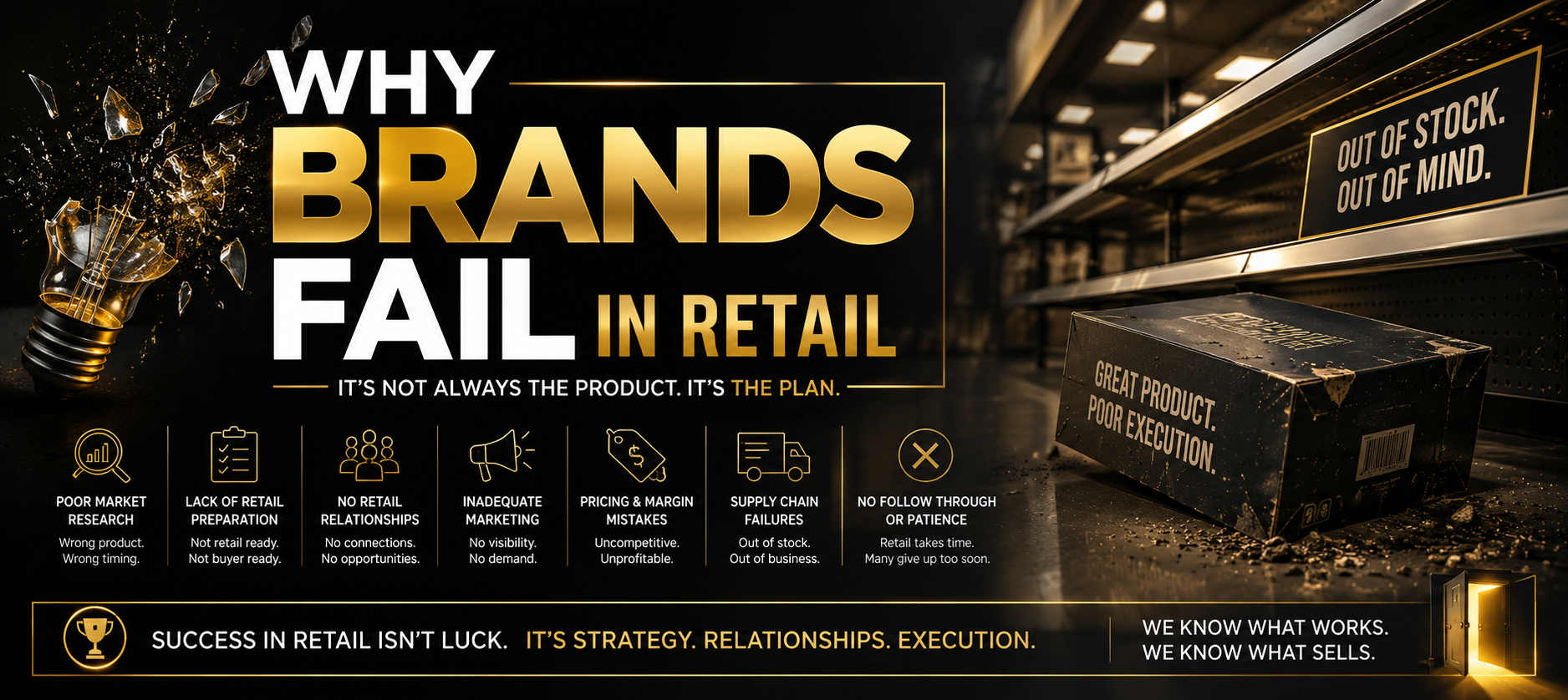
Why Brands Fail in Retail: Lessons From 34+ Years in the Industry
Great products fail every day.
That may be difficult for an entrepreneur, inventor, or brand owner to hear, but after more than 34 years working in the retail industry, I have seen it happen repeatedly.
A product can be innovative.
It can be patented.
It can win awards.
It can have beautiful packaging.
It can even get the attention of a major retail buyer.
And it can still fail.
Why?
Because retail success requires much more than having a great product.
It requires preparation, pricing, inventory, marketing, execution, patience, and the ability to listen.
At DPG Distribution, we have worked with hundreds of brands and products across multiple categories. Over the years, certain mistakes appear again and again.
Here are some of the most common reasons brands fail in retail.
1. They Believe a Great Product Will Sell Itself
This may be the biggest misconception in retail.
Brand owners are understandably passionate about their products. They have invested time, money, and energy into creating something they believe consumers need.
But consumers cannot buy a product they do not know exists.
Getting a product onto a shelf or a retailer’s website does not automatically create demand.
Products need support.
That may include:
Digital advertising
Social media
Public relations
Influencer marketing
Product demonstrations
Live shopping
Video content
Email marketing
Retail promotions
In-store merchandising
A purchase order is not a marketing plan.
Getting into retail is only the beginning.
2. They Are Not Retail Ready
Many brands approach major retailers too early.
They may have a product but lack the infrastructure and materials needed to support a retail opportunity.
Common problems include:
Packaging that is not retail ready
Missing UPC or GTIN information
No professional sell sheet
No product specification sheet
Poor product photography
No executive sales deck
Unclear pricing
Unknown case packs
Limited inventory
No marketing plan
When a buyer asks a question, the brand should be prepared.
Retail opportunities can move quickly.
If a buyer shows interest and the company needs several months to gather basic product information, the opportunity may disappear.
Preparation matters.
3. They Do Not Understand Retail Pricing
Pricing mistakes can destroy a retail opportunity before it begins.
Some brands establish a retail price without understanding:
Landed cost
Wholesale pricing
Retail margins
Distributor margins
Sales commissions
Marketplace fees
Freight
Promotional allowances
Marketing costs
Returns
Chargebacks
The numbers must work for everyone involved.
The manufacturer needs a sustainable business.
The retailer needs an appropriate margin.
The consumer needs to see value.
If the pricing structure does not support the sales channel, strong sales may actually create larger financial problems.
Know your numbers before approaching retail.
4. They Think Getting Into Retail Is the Finish Line
It is not.
Getting into retail is the starting line.
The real question is:
Will the product sell through?
Retailers measure performance.
If a product does not move, the retailer may reduce inventory, remove the product from the assortment, or replace it with another opportunity.
Brands need to think beyond the purchase order.
They should have a plan for:
Consumer awareness
Product education
Marketing
Promotions
Inventory
Replenishment
Customer support
Retail placement creates an opportunity.
Sell-through creates a business.
5. They Refuse to Listen
This is one of the most difficult problems to fix.
Sometimes a brand owner is so close to the product that they cannot see it from the perspective of a buyer or consumer.
They may hear:
The packaging needs improvement.
The price is too high.
The product story is confusing.
The assortment is too large.
The retailer is not the right fit.
And their response is:
“They just don’t understand my product.”
Sometimes that may be true.
But when experienced buyers, sales professionals, and industry experts repeatedly provide similar feedback, brands should listen.
Experience can help identify problems before those problems become expensive mistakes.
Feedback is not always criticism.
Sometimes it is an opportunity.
6. They Want Every Retailer
Not every product belongs in every store.
One of the most common questions we hear is:
“Can you get us into Walmart, Target, Costco, Best Buy, and Home Depot?”
Those retailers serve different customers.
They have different category strategies.
Different price points.
Different merchandising environments.
Different expectations.
A successful retail strategy begins by identifying the right retailers for the product.
The goal should not be to get into every retailer.
The goal should be to get into the right retailers.
7. They Have Unrealistic Expectations
Retail takes time.
Major retailers have:
Category reviews
Line reviews
Budget cycles
Planogram schedules
Vendor onboarding
Compliance requirements
Testing programs
A brand may have an outstanding product and still need to wait for the right opportunity.
We have seen companies become frustrated because they expected national retail placement within weeks.
Retail rarely works that way.
Relationships help open doors.
Preparation helps create opportunities.
But the retailer controls the final decision and timing.
Patience is part of the process.
8. They Do Not Have Enough Inventory
Imagine receiving an opportunity from a major retailer and then telling the buyer:
“We can have inventory in four months.”
Sometimes a retailer may wait.
Often, they may not.
Brands should understand:
Current inventory
Production capacity
Manufacturing lead times
Shipping times
Reorder capabilities
Retailers need confidence that a brand can support the opportunity.
Running out of inventory after a successful launch can be just as damaging as not getting the placement.
Success creates its own challenges.
Be prepared for success.
9. Their Packaging Does Not Sell the Product
Retail packaging is a salesperson sitting on the shelf.
In many stores, no one is standing next to your product explaining:
What it is.
How it works.
Why it is different.
Why the customer should buy it.
The packaging must help tell that story.
Common packaging mistakes include:
A consumer may give your product only a few seconds of attention.
Make those seconds count.
10. They Stop Marketing After Getting the Purchase Order
This happens more often than people think.
A brand spends money and energy trying to get into retail.
Then the purchase order arrives.
Marketing slows down.
That is exactly when marketing may be most important.
The brand now has an opportunity to tell consumers:
We are available.
Here is where you can buy us.
Here is why you should try the product.
Retail launches should be supported.
The retailer gave the brand shelf space or digital placement.
The brand needs to help create demand.
11. They Ignore eCommerce
Some brands still think of eCommerce and brick-and-mortar retail as completely separate businesses.
Consumers do not always shop that way.
A customer may:
See a product on social media.
Watch a product demonstration.
Research the product online.
Read reviews.
Visit a store.
Purchase online.
Pick up in store.
Modern retail is omnichannel.
Brands should think about the complete customer journey.
eCommerce can also help brands build sales history, generate reviews, test pricing, and demonstrate consumer interest.
The number one goal may be in-store retail.
But digital commerce can help support the journey to the shelf.
12. They Are Difficult to Work With
Retail is a relationship business.
Communication matters.
Professionalism matters.
Execution matters.
Retailers, distributors, sales representatives, and business partners want to work with companies that:
Every company will experience challenges.
How a company responds to those challenges can define the relationship.
Being a good partner matters.
13. They Do Not Understand the Retailer’s Customer
The retailer is not buying the product for themselves.
They are buying for their customer.
Brands need to understand:
Who shops at this retailer?
What price points do they expect?
What products are already in the category?
Why would this customer buy our product?
Your product presentation should be built around the retailer and its customer.
A generic presentation sent to every buyer may miss the real opportunity.
14. They Give Up Too Soon
Retail can be frustrating.
Emails go unanswered.
Meetings get moved.
Category reviews change.
Buyers change positions.
Budgets change.
Priorities change.
A “no” today does not always mean “no forever.”
Timing matters.
The product may not fit the current planogram.
The category may already be full.
The buyer may have recently added another brand.
Professional follow-up and long-term relationship building are part of retail sales.
Persistence matters.
15. They Choose the Wrong Partners
The people representing your brand matter.
Brands should carefully evaluate:
Sales representatives
Distributors
Marketing agencies
Logistics providers
eCommerce partners
International partners
Ask questions.
Understand their experience.
Understand their relationships.
Understand how they operate.
The right partners can help identify opportunities and avoid mistakes.
The wrong partners can cost a brand time, money, and credibility.
What 34+ Years in Retail Has Taught Me
After more than three decades in this industry, one lesson stands above the rest:
Retail rewards preparation and execution.
I have seen outstanding products fail because the company was not ready.
I have also seen simple products become successful because the company listened, prepared, marketed, and executed.
There is no magic formula.
There are no guaranteed purchase orders.
There are no shortcuts to building a sustainable retail business.
But experience matters.
Relationships matter.
Preparation matters.
And execution matters.
How DPG Distribution Helps Brands Navigate Retail
Since 2011, DPG Distribution has worked with brands across multiple product categories and retail channels.
Our team helps brands evaluate and prepare for retail opportunities through:
Retail sales representation
Retail strategy
Buyer introductions
Product positioning
Retail Ready preparation
Sell sheet guidance
Product specification materials
Executive sales presentations
Packaging guidance
In-store merchandising concepts
eCommerce strategy
Live shopping opportunities
International expansion opportunities
Our goal is not simply to introduce a product.
Our goal is to help brands better understand the complex world of retail.
Frequently Asked Questions
Why do good products fail in retail?
Good products can fail because of poor pricing, weak marketing, insufficient inventory, lack of retail preparation, poor packaging, or execution problems.
Does getting a purchase order mean a product will succeed?
No. A purchase order creates an opportunity. Long-term success depends heavily on sell-through, marketing, inventory, and execution.
How long does it take to get into major retail?
The timeline varies by retailer, category, product, and opportunity. Major retailers may operate around category reviews, line reviews, and planogram schedules.
Do brands need marketing after getting into retail?
Yes. Brands should have a strategy to create consumer awareness and support product sell-through.
Should every brand sell to Walmart or Costco?
No. Brands should identify retailers whose customers, price points, and category strategies align with the product.
Can a manufacturers’ sales representative guarantee retail placement?
No. Retailers make their own purchasing decisions. Experienced sales representatives can help identify opportunities, prepare brands, and present products to appropriate retail contacts.
Great Products Need Great Companies Behind Them
Creating a product is difficult.
Building a brand is harder.
Building a successful retail business requires preparation, patience, investment, relationships, and execution.
Great products create opportunities. Great companies know how to execute them.
Written by George W. Davison, Founder & CEO of DPG Distribution | 34+ Years of Retail Industry Experience.
 Toll Free (866) 416-4297