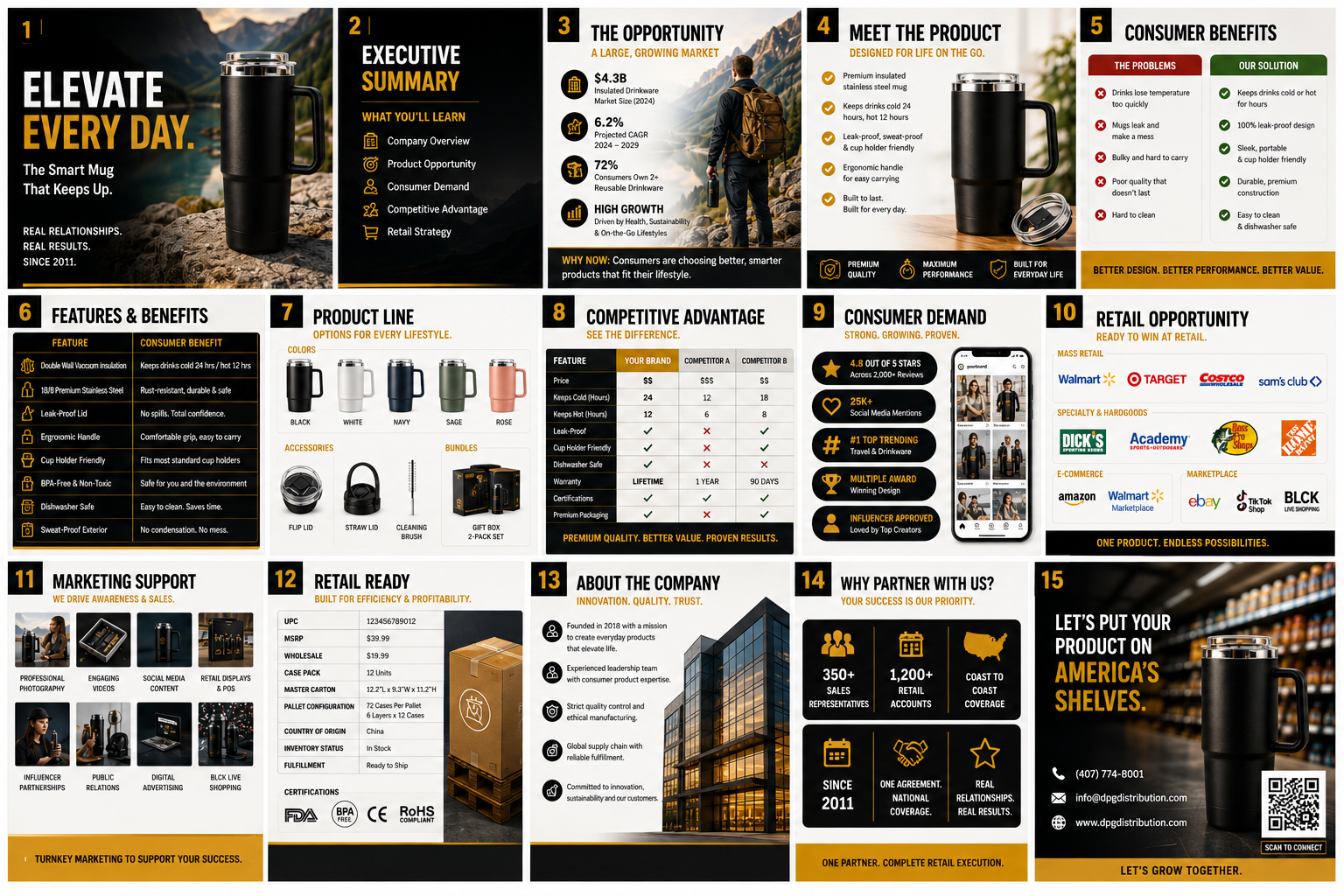
How to Create a Sales Deck: A Guide for Brands Preparing for Retail
A great product can lose a retail opportunity because of a poor presentation.
When presenting to a retail buyer, distributor, sales representative, or strategic partner, your sales deck is often one of the first opportunities to tell your complete story.
A professional sales deck should clearly explain your company, your product, the consumer opportunity, and why your brand may be a strong fit for retail.
The goal is not to create the longest presentation.
The goal is to create a presentation that makes your opportunity easy to understand.
What Is a Sales Deck?
A sales deck is a visual presentation used to introduce a company, brand, product, or business opportunity to a potential buyer or business partner.
For brands preparing for retail, a sales deck may be used during:
Retail buyer meetings
Product presentations
Distributor meetings
Sales representative presentations
Virtual meetings
Trade shows
Strategic partnership discussions
International sales presentations
A strong sales deck guides the conversation.
It helps the audience understand where the company has been, what the product offers, and where the opportunity may be going.
Your Sales Deck Should Tell a Story
One of the most common mistakes brands make is treating a sales deck like a product catalog.
A catalog shows products.
A sales deck tells a story.
Your presentation should have a clear beginning, middle, and end.
A simple retail sales story may look like this:
The Problem
What consumer problem or market opportunity exists?
The Solution
How does your product address that problem?
The Difference
Why is your product or brand different?
The Opportunity
Why could the product be relevant to the retailer and its customers?
The Support
How will your company support the product?
The Next Step
What do you want to happen after the presentation?
Every slide should help move the story forward.
Start With a Strong Cover Slide
Your cover slide creates the first impression.
Keep it professional and simple.
A cover slide may include:
Avoid placing too much information on the cover.
The goal is to create interest and establish the visual tone for the presentation.
A strong cover should look like the beginning of an important business conversation.
Introduce the Company
Retail buyers want to understand who they may be doing business with.
Your company overview should be concise.
Consider including:
Year founded
Company headquarters
Management experience
Company mission
Current distribution
Key accomplishments
Patents or intellectual property
Manufacturing capabilities
Existing retail or eCommerce presence
Avoid turning the presentation into a long company history lesson.
Focus on information that builds confidence in the business.
The buyer wants to understand whether your company can support the opportunity.
Clearly Define the Consumer Problem
Why does your product exist?
Strong products often solve a problem, improve an experience, or create a new opportunity.
Explain the consumer problem clearly.
Examples may include:
An existing product is difficult to use
Consumers are looking for a more convenient solution
Current products lack an important feature
A category has changed
Consumer behavior is evolving
New technology has created an opportunity
The problem should be easy to understand.
If the audience does not understand the problem, they may not understand the value of your solution.
Present Your Product as the Solution
Once the problem is established, introduce the product.
Clearly explain:
What the product is
What the product does
Who uses it
How it works
Why it is valuable
Use professional product photography.
Whenever possible, show the product in use.
The audience should be able to understand the product without reading paragraphs of text.
Visual communication is powerful.
Focus on Benefits, Not Just Features
Features describe the product.
Benefits explain why customers care.
For example:
Feature: Rechargeable lithium battery.
Benefit: Customers can use the product without repeatedly purchasing replacement batteries.
Feature: Compact folding design.
Benefit: Easy to store and transport.
Feature: App connectivity.
Benefit: Customers can control and monitor the product from their smartphone.
Your sales deck should communicate both features and consumer benefits.
The buyer needs to understand why the product may appeal to customers.
Explain What Makes Your Product Different
Retail buyers see many products.
Your presentation should clearly answer:
Why this product?
Your differentiation may include:
Do not simply say your product is “innovative.”
Explain why.
Specific information is more credible than broad marketing claims.
Identify the Target Customer
Who is going to buy the product?
Your sales deck should clearly identify the target consumer.
Consider including:
Age range
Lifestyle
Interests
Shopping behavior
Product usage
Consumer needs
Relevant demographics
Avoid saying:
“Our product is for everyone.”
Very few products are truly for everyone.
A clearly defined target customer helps a retail buyer understand where the product fits within their business.
Explain the Market Opportunity
When appropriate, include credible market information.
This may include:
Use reliable sources.
Clearly identify where market statistics come from.
Do not overload the presentation with charts and data.
Use information that helps support the product opportunity.
Show the Competitive Landscape
Retail buyers may already understand the category.
Your presentation should demonstrate that you do too.
Consider showing:
Existing competitors
Price points
Product differences
Feature comparisons
Market positioning
A simple comparison chart can be effective.
However, remain professional.
Do not attack competitors.
Focus on explaining how your product is positioned differently.
Present the Product Line
If you have multiple products, present the product assortment clearly.
For each product, consider showing:
Avoid placing too many products on one slide.
The buyer should be able to understand the assortment quickly.
If you have a large product catalog, highlight the products most relevant to the retailer.
Show Retail-Ready Packaging
Retail packaging matters.
Include professional images or renderings of the packaging.
A buyer may want to understand:
Shelf presence
Packaging dimensions
Product communication
Branding
UPC placement
Merchandising options
If your packaging is still under development, clearly identify images as concepts or renderings.
Never present a concept as a finished production package.
Accuracy builds trust.
Show In-Store Merchandising Ideas
Help the buyer visualize the product in retail.
Depending on the category, consider showing:
These concepts do not guarantee placement.
The retailer ultimately determines its merchandising strategy and planograms.
However, professional merchandising concepts can demonstrate preparation and help communicate the product opportunity.
Explain Your Marketing Strategy
Getting into retail is only part of the challenge.
Products need to sell through.
Your sales deck should explain how your company plans to create consumer awareness and support sales.
Marketing support may include:
Digital advertising
Social media
Influencer marketing
Public relations
Email marketing
Product demonstrations
Live shopping
Video content
Retail promotions
In-store marketing
Be specific.
Instead of saying:
“We will support the launch with marketing.”
Explain what that support may look like.
A marketing plan demonstrates commitment to the product’s success.
Include Sales History and Traction
If you have sales history, use it.
Relevant information may include:
Use accurate information.
Do not exaggerate.
Buyers may ask detailed questions about the numbers presented.
If your company is new and does not have significant sales history, focus on the product opportunity, consumer problem, differentiation, and launch strategy.
Explain Your Retail Strategy
Show that you have thought about how the product fits into retail.
Your retail strategy may include:
Not every product should launch everywhere at the same time.
A focused retail strategy can be more credible than simply listing every major retailer in the country.
Include Important Product and Logistics Information
A buyer may need to understand the operational side of the opportunity.
Depending on the presentation, include:
MSRP
MAP pricing
Wholesale pricing
Retail margin
Case pack
Master carton dimensions
Product dimensions
Product weight
Country of origin
Lead times
Current inventory
Production capacity
Detailed information may also be provided in a separate Product Specification Sheet.
The sales deck should remain easy to review.
End With a Clear Next Step
Do not allow the presentation to simply end.
Tell the audience what happens next.
Examples include:
Let’s Schedule a Product Review
Samples Available Upon Request
Let’s Discuss a Retail Test
Request Additional Product Information
Explore the Opportunity
Include professional contact information.
Make it easy to continue the conversation.
How Many Slides Should a Sales Deck Have?
There is no perfect number.
However, many effective sales presentations are approximately 10 to 20 slides.
The presentation should be long enough to tell the story and short enough to maintain attention.
Every slide should answer an important question.
If a slide does not help explain the opportunity, consider removing it.
More slides do not necessarily create a stronger presentation.
Common Sales Deck Mistakes
Brands should avoid:
Too much text
Small fonts
Low-resolution images
Generic stock photography
Inconsistent branding
Unverified market statistics
Complicated charts
Too many products per slide
No clear target customer
No marketing strategy
No product differentiation
No clear next step
Another common mistake is creating one presentation and using it for every retailer.
Your core sales deck may remain consistent, but the presentation should be reviewed and adjusted for the specific audience.
Customize the Presentation for the Retailer
A presentation to a consumer electronics retailer may be different from a presentation to a warehouse club.
A hardware retailer may evaluate different factors than a beauty retailer.
Before a meeting, consider:
The retailer’s customer
Current assortment
Price points
Store format
eCommerce strategy
Category positioning
Whenever possible, explain why the product may fit that specific retailer.
Preparation demonstrates professionalism.
Sell Sheet vs. Sales Deck
A sell sheet provides a quick overview.
A sales deck tells the complete story.
The sell sheet may be reviewed in seconds.
The sales deck guides a longer presentation and business conversation.
Professional brands should consider preparing both.
The documents should use consistent branding, photography, product information, and messaging.
How DPG Distribution Helps Brands Prepare for Retail
At DPG Distribution, we have spent decades working in the retail industry.
We understand that professional presentation materials can play an important role in how a brand is introduced to a retail opportunity.
Through our Retail Ready process, we help brands evaluate and improve:
Our goal is to help brands present their products professionally and clearly.
You may only get one opportunity to make a first impression.
Make it count.
Frequently Asked Questions
What is a sales deck?
A sales deck is a visual presentation used to explain a company, product, and business opportunity to a potential buyer or business partner.
How many slides should a retail sales deck have?
Many sales decks are approximately 10 to 20 slides, although the appropriate length depends on the product and presentation.
Should I include pricing?
In many retail presentations, pricing information is important. Brands should be prepared to discuss MSRP, wholesale pricing, retail margins, and MAP pricing when applicable.
Should I include market statistics?
Market statistics can help support an opportunity when they come from credible sources and are directly relevant to the product.
Can I use the same sales deck for every retailer?
A core presentation can be used as a starting point, but brands should review and customize the deck for the retailer and audience.
Should I send the sales deck before a buyer meeting?
This depends on the situation. In some cases, a short sell sheet may be appropriate before a meeting, with the complete sales deck used during the presentation.
Your Presentation Represents Your Brand
Before a buyer experiences your product, visits your factory, or meets your entire team, they may see your sales presentation.
That presentation communicates more than product information.
It communicates preparation.
It communicates professionalism.
It communicates how seriously you take the opportunity.
A great product starts the story. A professional sales deck helps you tell it.
Written by George W. Davison, Founder & CEO of DPG Distribution | 34+ Years of Retail Industry Experience
 Toll Free (866) 416-4297