MAP Pricing Explained: What Brands Need to Know Before Selling to Retail
Pricing can make or break a retail strategy.
One of the most misunderstood terms in retail is MAP pricing.
Brands often confuse MAP with MSRP, wholesale pricing, or a required retail selling price. These terms are not the same.
Understanding the difference is important when preparing to sell through retailers, eCommerce websites, online marketplaces, distributors, and other sales channels.
What Is MAP Pricing?
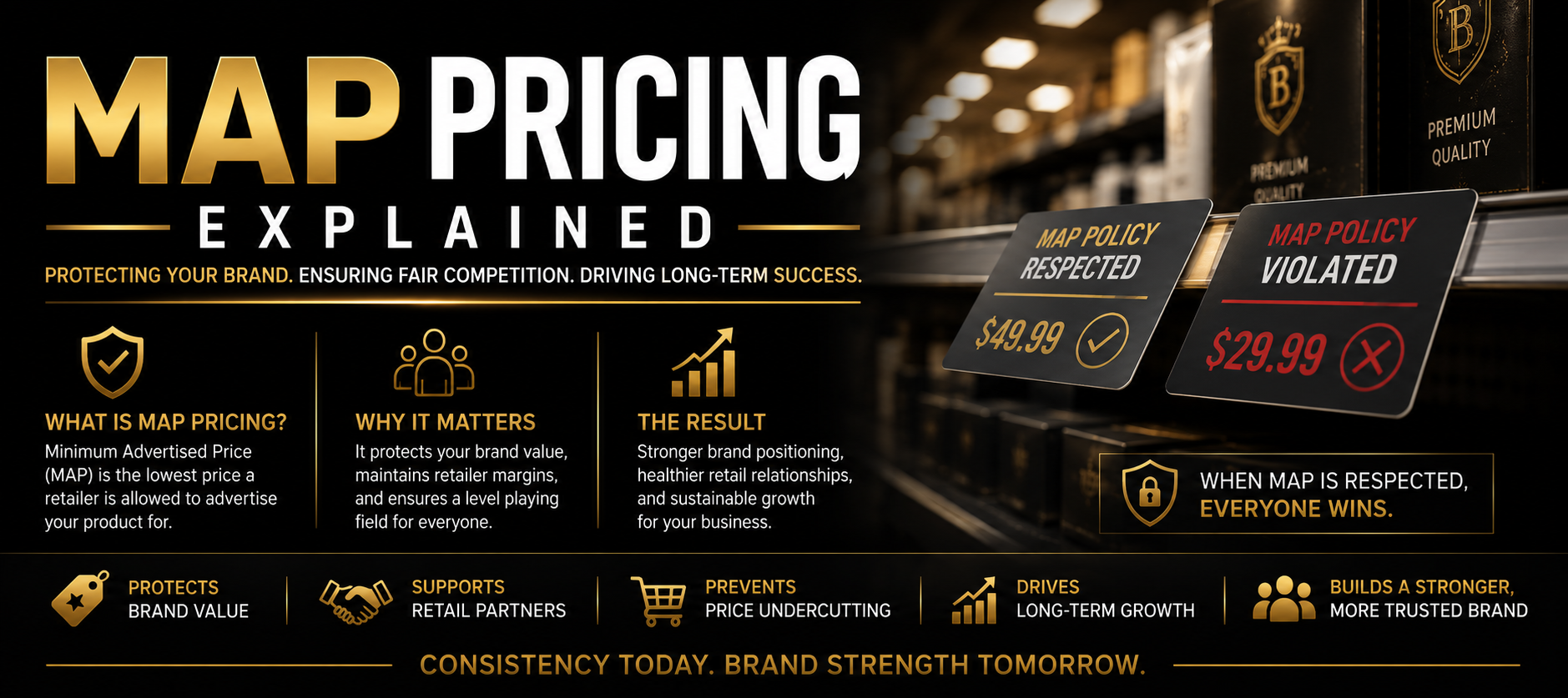
MAP stands for Minimum Advertised Price.
A MAP policy generally establishes the lowest price at which an authorized seller may publicly advertise a product.
For example:
MSRP: $199.99
MAP: $179.99
Under a brand’s MAP policy, an authorized seller may be restricted from publicly advertising the product below $179.99, depending on the terms of the policy and applicable law.
The key word is:
Advertised.
MAP pricing generally focuses on how a product’s price is publicly advertised.
It is important to understand that MAP policies are not simply another name for retail pricing.
MAP vs. MSRP
MAP and MSRP serve different purposes.
MAP — Minimum Advertised Price
The lowest price at which a product may be publicly advertised under a brand’s MAP policy.
MSRP — Manufacturer’s Suggested Retail Price
The retail price suggested by the manufacturer.
The word suggested is important.
For example:
MSRP: $199.99
MAP: $179.99
The manufacturer may suggest a retail price of $199.99 while establishing a MAP policy that addresses advertising below $179.99.
Brands should clearly understand these differences before communicating pricing to retailers.
MAP vs. Wholesale Price
Wholesale price is the price charged to the retailer, distributor, or other authorized customer purchasing the product.
For example:
Wholesale Price: $100.00
MAP: $179.99
MSRP: $199.99
These three numbers serve different purposes.
The wholesale price affects the retailer’s cost and potential margin.
MAP relates to advertised pricing under the brand’s policy.
MSRP is the manufacturer’s suggested retail price.
A professional pricing strategy should consider all three.
Why Brands Use MAP Policies
Brands may establish MAP policies to help support:
Brand positioning
Consistent advertised pricing
Authorized dealer networks
Retailer confidence
Product value perception
Sustainable channel relationships
Long-term pricing strategy
Without a thoughtful pricing strategy, products may experience significant advertised price erosion.
One seller lowers the advertised price.
Another seller responds.
Additional sellers follow.
Eventually, the product may become associated primarily with discounting rather than its features, benefits, or brand value.
This is sometimes referred to as a race to the bottom.
MAP Can Help Protect Brand Positioning
Pricing communicates something to consumers.
A premium product that is consistently advertised at heavily discounted prices may begin to lose its premium positioning.
For example, imagine a product launches with an MSRP of $299.99.
Within several months, multiple online sellers begin publicly advertising the product for:
$249.99
$219.99
$189.99
$159.99
Consumers may begin to question the product’s actual value.
They may also delay purchases because they expect the price to continue falling.
A well-developed pricing and channel strategy may help brands manage how their products are positioned in the marketplace.
Retailers Care About Margin
Retail buyers evaluate more than the consumer selling price.
They also consider the potential financial opportunity for the retailer.
A simplified retail margin calculation is:
Retail Price – Retailer Cost = Gross Margin Dollars
For example:
Retail Price: $100
Retailer Cost: $60
Gross Margin Dollars: $40
The gross margin percentage based on retail selling price would be 40%.
Retail margin expectations vary by retailer, product category, program, and sales channel.
Brands should understand their pricing structure before approaching retail buyers.
Build Your Pricing Strategy Before Approaching Retail
One of the biggest mistakes brands make is developing pricing after a retail opportunity appears.
Before approaching retailers, brands should understand:
Every layer of the sales channel may affect the final economics of the product.
A product can generate strong sales and still create financial problems if the pricing model was not properly developed.
What Is Landed Cost?
Landed cost is the total cost associated with getting a product to the point where it is ready for sale or distribution.
Depending on the business, landed cost may include:
Manufacturing cost
Freight
Duties
Tariffs
Insurance
Customs fees
Brokerage fees
Warehousing
Handling
Brands should understand their landed cost before establishing wholesale pricing.
Ignoring these costs can create unrealistic margins.
What About Promotions and Sales Events?
Retailers frequently run promotions.
Examples may include:
Brands should consider promotional strategy when developing pricing policies.
Questions may include:
Will promotional advertising be addressed in the MAP policy?
Are there specific promotional periods?
How are approved promotions communicated?
Who within the company manages MAP questions?
Clear policies and consistent communication can help reduce confusion with authorized sellers.
MAP and Online Marketplaces
Online marketplaces have made pricing management more complex.
A product may appear across:
Retailer websites
Third-party marketplaces
Independent dealer websites
Comparison shopping platforms
Social commerce platforms
Unauthorized sellers may also appear.
Brands should regularly review how their products are represented online.
This may include monitoring:
Advertised pricing
Seller identity
Product listings
Product images
Product descriptions
Brand content
MAP is only one part of a larger channel management strategy.
Authorized vs. Unauthorized Sellers
An authorized seller is generally a retailer, distributor, dealer, or other business approved by the brand to sell its products.
Unauthorized sellers may obtain products through:
Liquidation
Diversion
Secondary distribution
Resellers
Other supply channels
Unauthorized sellers can create challenges involving:
Pricing
Product listings
Customer service
Warranty questions
Brand representation
Brands should understand their distribution channels and know who is selling their products.
Strong channel management begins with visibility.
Should Every Brand Have a MAP Policy?
Not necessarily.
The appropriate pricing strategy depends on:
Product category
Brand positioning
Distribution strategy
Retail channels
Competitive environment
Business objectives
A premium brand with a network of authorized dealers may have different pricing considerations than a value-focused product sold primarily through one marketplace.
Brands should develop a pricing strategy that supports their long-term goals.
MAP Policies Should Be Developed Carefully
MAP policies can involve important legal considerations.
Brands should not simply download another company’s MAP policy, change the company name, and begin using it.
Pricing and distribution laws may vary based on jurisdiction and business practices.
Companies considering a MAP policy should consult qualified legal counsel familiar with antitrust, pricing, and distribution matters.
This article is provided for general educational purposes and is not legal advice.
Common MAP Pricing Mistakes
Brands should avoid:
Confusing MAP with MSRP
Confusing MAP with wholesale pricing
Creating unrealistic retail margins
Ignoring marketplace fees
Failing to understand landed cost
Developing inconsistent policies
Poor communication with sellers
Ignoring unauthorized sellers
Failing to monitor advertised pricing
Copying another company’s MAP policy without legal review
Pricing strategy should be developed before the product is widely distributed.
Correcting pricing problems after they spread across multiple sales channels can be difficult.
How DPG Distribution Helps Brands Prepare for Retail
At DPG Distribution, we work with brands preparing to present products to retail, eCommerce, live shopping, and other sales channels.
As part of the retail preparation process, brands should clearly understand their pricing structure and be prepared to communicate accurate information regarding:
Our goal is to help brands identify important retail questions before they are sitting in front of a buyer.
Preparation creates better conversations.
Frequently Asked Questions
What does MAP stand for?
MAP stands for Minimum Advertised Price.
Is MAP the same as MSRP?
No. MAP generally relates to the lowest price at which a product may be publicly advertised under a brand’s policy. MSRP is the manufacturer’s suggested retail price.
Is MAP the same as wholesale price?
No. Wholesale price is the price charged to the retailer, distributor, or other authorized customer purchasing the product.
Why do brands use MAP policies?
Brands may use MAP policies as part of a broader strategy involving brand positioning, advertised pricing, and authorized seller relationships.
Does every brand need MAP pricing?
No. The appropriate pricing strategy depends on the product, category, brand positioning, and distribution model.
Can I copy another brand’s MAP policy?
Companies should develop policies appropriate for their own business and seek qualified legal advice when addressing pricing and distribution matters.
Should I understand MAP before approaching retailers?
Yes. Brands should understand their wholesale pricing, MSRP, retail margin structure, and MAP strategy, when applicable, before presenting products to retailers.
Pricing Is Part of Your Retail Strategy
Pricing is more than choosing a number.
It affects retailers.
It affects distributors.
It affects sales channels.
It affects consumers.
And it affects how your brand is positioned in the marketplace.
Before approaching retail, understand your numbers and build a pricing strategy designed to support long-term growth.
Know your costs. Know your margins. Know your strategy.
Written by George W. Davison, Founder & CEO of DPG Distribution | 34+ Years of Retail Industry Experience
 Toll Free (866) 416-4297