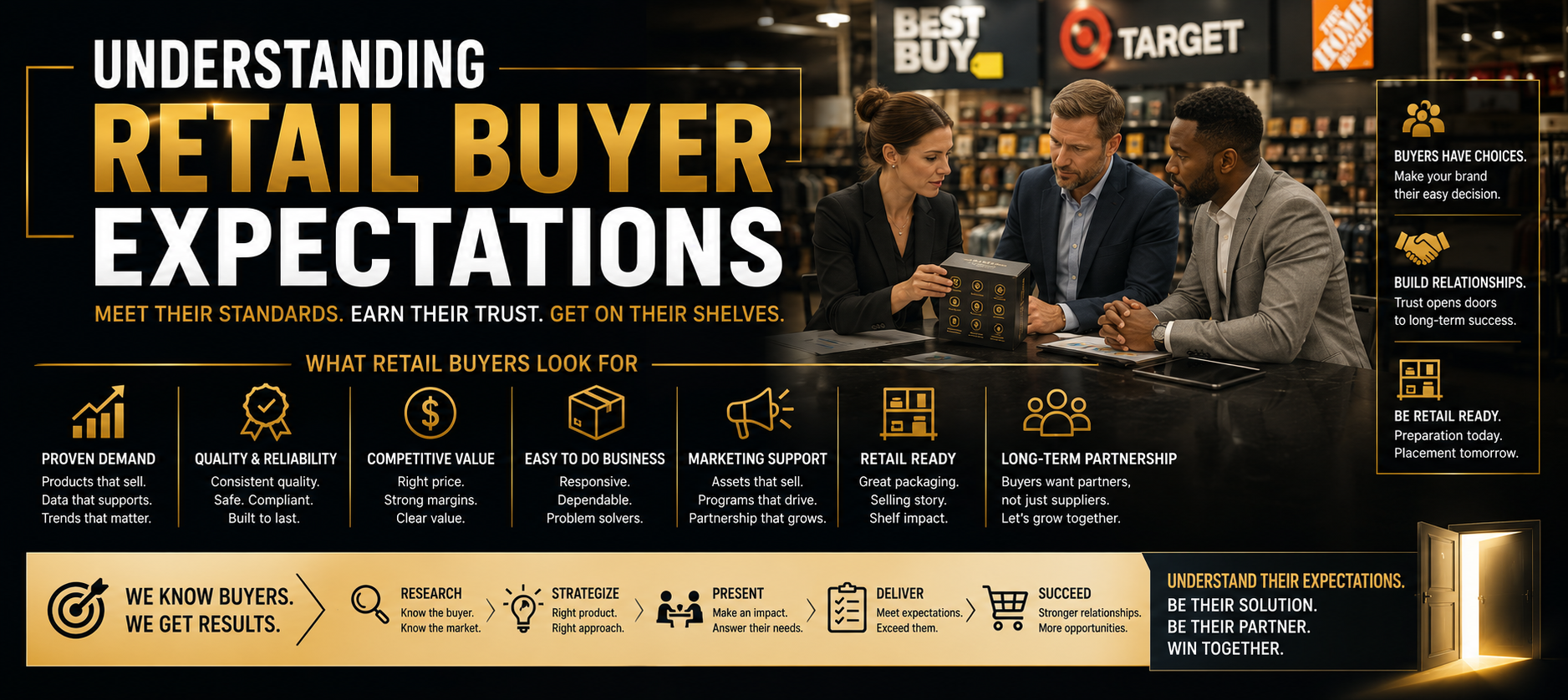
Understanding Retail Buyer Expectations: What Brands Need to Know
Getting a product in front of a major retail buyer is an important opportunity. But getting the meeting is only the beginning.
Retail buyers evaluate hundreds, and sometimes thousands, of products and brands. They must determine which products deserve valuable shelf space, fit their customers, support the retailer’s category strategy, and have the operational ability to succeed.
A great product alone is not always enough.
Brands must understand what retail buyers expect before entering the conversation.
Retail Buyers Are Evaluating More Than the Product
One of the biggest mistakes brands make is assuming a buyer is only evaluating the product.
The buyer is evaluating the entire opportunity.
That may include:
A buyer may love a product but still decide the company is not ready for retail.
Retail readiness matters.
Buyers Want to Understand the Opportunity Quickly
Retail buyers are busy.
Your presentation should make it easy for them to understand your product and the business opportunity.
Within a short period of time, a buyer should be able to answer several basic questions:
What is the product?
What problem does it solve?
Who is the customer?
Why will consumers buy it?
What makes it different?
What is the retail price?
What is the opportunity for the retailer?
If the buyer has to search through a 50-page presentation to understand the product, the presentation may already be working against you.
Clear communication matters.
Buyers Expect Professional Sales Materials
The way a product is presented can influence how a buyer views the company behind it.
Brands approaching major retailers should be prepared with professional materials, including:
Product sell sheets
Product specification sheets
Executive sales presentations
High-resolution product photography
Retail pricing information
Case pack details
Product dimensions
UPC or GTIN information
Packaging specifications
Inventory information
Marketing plans
These materials should be accurate, professional, and easy to understand.
Your sales presentation is often one of the buyer’s first impressions of your company.
Make it count.
Retail-Ready Packaging Matters
Packaging is an important part of the buyer’s evaluation.
A buyer may consider:
Does the packaging clearly explain the product?
Can customers understand the product quickly?
Is the packaging appropriate for the retail environment?
Does it fit on a shelf, peg hook, or display?
Is the UPC properly positioned?
Are the product benefits clearly communicated?
Does the packaging protect the product?
Does the packaging look competitive within the category?
Retail packaging is not simply a shipping container.
It is a salesperson sitting on the shelf.
In many retail environments, the packaging must communicate the product’s value without anyone standing nearby to explain it.
Buyers Think About Shelf Space
Retail shelf space is valuable.
Every new product may compete with an existing product for placement.
That means a buyer may ask:
Why should I give this product shelf space?
Brands should be prepared to explain how their product adds value to the category.
That value may come from:
Product innovation
Consumer demand
Better margins
A new customer demographic
A unique product feature
Strong marketing support
Incremental category sales
Competitive differentiation
The goal is not simply to convince the buyer that your product is good.
The goal is to demonstrate why the product may be a good opportunity for the retailer and its customers.
Buyers Expect You to Know Your Numbers
Brands should understand their business before presenting to a major retailer.
Important information may include:
If a buyer asks a basic product or pricing question, the brand should be prepared to provide an accurate answer.
Guessing can damage credibility.
If you do not know the answer, it is better to confirm the information and follow up accurately.
Marketing Support Is Important
Getting into retail and succeeding in retail are two different things.
Retailers want products to sell.
Brands should be prepared to discuss how they plan to create consumer awareness and support sell-through.
Marketing support may include:
Digital advertising
Social media
Influencer campaigns
Public relations
Product demonstrations
Live shopping
Video content
Email marketing
Retail promotions
In-store merchandising
Consumer education
A retailer should not be expected to build your brand for you.
Brands need a plan to help drive consumer demand.
Buyers Expect Reliable Inventory and Execution
A purchase order is not the finish line.
It is the beginning of the retail relationship.
Brands must be prepared to execute.
Retailers may expect accurate:
Order processing
Inventory management
Shipping
Labeling
Packaging
Documentation
Invoicing
Product information
Late shipments, inventory shortages, incorrect labels, inaccurate product data, and poor communication can create serious problems.
Retail is built on execution.
The ability to deliver consistently can be just as important as the initial product presentation.
Understand the Retailer’s Customer
Not every product belongs in every retailer.
A product that performs well in one retail channel may not be right for another.
Before approaching a retailer, brands should understand:
Your presentation should explain why the product fits that specific retailer.
A generic presentation sent to every buyer is rarely the strongest strategy.
Buyers Value Preparation
Preparation demonstrates professionalism.
Before a buyer meeting, brands should be prepared to discuss:
The strongest presentations are often the ones that answer the buyer’s questions before the buyer has to ask them.
Relationships Open Doors. Preparation Creates Opportunities.
Relationships are an important part of the retail industry.
The right relationship may help a product reach the appropriate buyer.
But the product, brand, and company must still be prepared for the opportunity.
At DPG Distribution, we have spent decades working in the retail industry and developing relationships across multiple retail channels and product categories.
We understand that getting in front of a buyer is only part of the process.
Our goal is to help brands prepare, present, and position their products professionally for retail opportunities.
How DPG Distribution Helps Brands Prepare for Retail
DPG Distribution works with brands across multiple product categories to help develop and execute retail sales strategies.
Our experience includes:
Retail sales representation
Buyer introductions
Retail strategy
Product positioning
Retail-ready preparation
Sell sheet development
Product specification materials
Executive sales presentations
Packaging guidance
In-store display concepts
eCommerce strategy
Live shopping opportunities
International expansion opportunities
Since 2011, DPG Distribution has worked to connect brands, products, sales professionals, and retail opportunities.
Real relationships. Real experience. Real results.
Frequently Asked Questions
What do retail buyers look for in a new product?
Retail buyers may evaluate consumer demand, product differentiation, retail margins, category fit, packaging, marketing support, inventory availability, and the brand’s ability to execute.
Do I need sales history before approaching a major retailer?
Not always. However, sales history can help demonstrate consumer demand. New brands should be prepared to clearly explain their product differentiation, target customer, marketing strategy, and ability to support a retail launch.
How important is packaging to a retail buyer?
Packaging can be extremely important. It helps communicate the product’s value to consumers and may influence how the product fits into the retailer’s merchandising environment.
Do retailers expect brands to provide marketing support?
Marketing expectations vary by retailer and program, but brands should generally be prepared to explain how they plan to create awareness and support product sell-through.
Can a sales representative guarantee retail placement?
No professional sales representative should guarantee that a retailer will purchase a product. Retail buyers and retailers make their own purchasing decisions. Experienced retail sales representatives can help brands prepare, identify opportunities, and present products to appropriate retail contacts.
What should I bring to a retail buyer meeting?
Brands should be prepared with professional sales materials, accurate pricing, product specifications, packaging information, inventory details, marketing plans, and a clear explanation of the retail opportunity.
Prepare Before the Opportunity Arrives
Retail opportunities can move quickly.
When a buyer shows interest, brands should be ready.
Professional materials, accurate information, retail-ready packaging, available inventory, and a clear marketing strategy can make the difference between simply presenting a product and building a long-term retail opportunity.
Is your product retail ready?
DPG Distribution helps brands prepare for the complex world of retail sales, eCommerce, live shopping, and national retail expansion.
Written by George W. Davison, Founder & CEO of DPG Distribution | 34+ Years of Retail Industry Experience
 Toll Free (866) 416-4297