Toll Free (866) 416-4297
Have a new product or invention you'd like to bring to market?

EDI Requirements

Electronic Data Interchange (EDI): The Language of Retail

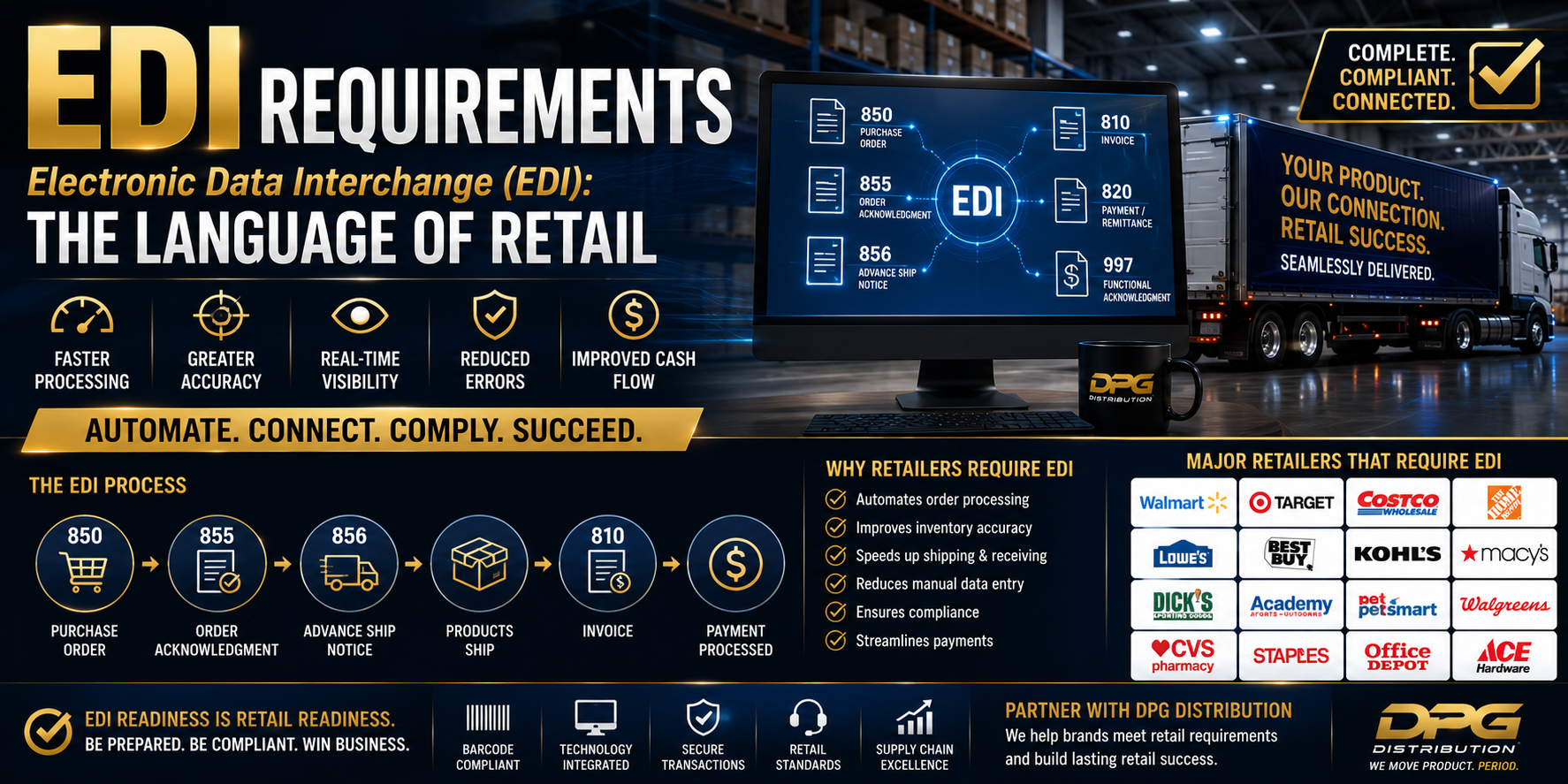
Electronic Data Interchange (EDI) is the standardized method retailers use to exchange business documents electronically with suppliers. Most major retailers require EDI before they will issue purchase orders or onboard a new vendor.

Without EDI capabilities, fulfilling orders for many national retailers may not be possible.


What Is EDI?

EDI allows retailers and suppliers to exchange critical business documents automatically, eliminating manual data entry, reducing errors, and accelerating order processing.

Common EDI documents include:

  • Purchase Orders (850)
  • Purchase Order Acknowledgments (855)
  • Advance Ship Notices (856)
  • Invoices (810)
  • Inventory Reports (846)
  • Purchase Order Changes (860)
  • Functional Acknowledgments (997)
  • Payment and Remittance Advice (820)

Why Retailers Require EDI

Retailers depend on EDI to:

  • Automate order processing
  • Improve inventory accuracy
  • Reduce fulfillment errors
  • Speed up shipping
  • Increase supply chain visibility
  • Simplify invoicing and payments
  • Ensure compliance with vendor requirements

For suppliers, EDI reduces administrative work while improving operational efficiency.


Major Retailers That Commonly Require EDI

Many national retailers require EDI, including:

  • Walmart
  • Target
  • Costco
  • Home Depot
  • Lowe’s
  • Best Buy
  • Kohl’s
  • Macy’s
  • Dick’s Sporting Goods
  • Academy Sports + Outdoors
  • Tractor Supply
  • Walgreens
  • CVS
  • Staples
  • Office Depot
  • Ace Hardware
  • PetSmart
  • Camping World

Requirements vary by retailer and supplier program.


Typical EDI Workflow

  • Retailer issues a Purchase Order (850)
  • Supplier acknowledges the order (855)
  • Products are prepared for shipment
  • Advance Ship Notice (856) is transmitted
  • Products ship to the retailer or distribution center
  • Electronic Invoice (810) is submitted
  • Payment is processed electronically

This standardized process keeps both parties synchronized throughout the transaction.


Before You Go Live

Ensure your company has:

  • An EDI provider or platform
  • ERP or inventory system integration (if applicable)
  • Internal EDI testing completed
  • Barcode compliance
  • GS1 UPC registration
  • Shipping label compliance
  • Retail routing guide compliance
  • ASN (Advance Ship Notice) capabilities
  • Electronic invoicing
  • Customer support procedures for EDI transactions

Common EDI Solutions

Many brands work with third-party EDI providers that integrate with their existing ERP, accounting, or order management systems. These providers can simplify implementation and ongoing compliance with retailer-specific requirements.


DPG Recommendation

If your goal is to sell through major retailers, EDI readiness should be part of your retail launch plan—not an afterthought. Establishing your EDI capabilities before buyer meetings demonstrates operational maturity and gives retailers confidence that your company can process orders accurately and efficiently from day one.

Retail buyers expect suppliers to be operationally ready. EDI is one of the key systems that helps move your product from purchase order to the retail shelf.

Written by George W. Davison, Founder & CEO of DPG Distribution | 34+ Years of Retail Industry Experience.


A sleek black and gold rectangular badge reading 'DPG Retail Ready Approved - Verified by DPG Distribution' featuring a corporate seal and verification layout.