 Toll Free (866) 416-4297
About DPG
- DPG Retail Ready™
- About DPG
- Categories We Sell
- Who We Call On
- Why Use DPG Distribution?
- Mission and Objectives
- Industry Leader
- Your Company Extension
- Your Partner in Retail Growth
- DPG Core Values
- Meet Our CEO
- Sell your Brand on TV
- Sell your Brand in Brazil
- Video Library
- News and Trade Shows
- DPG Brand Book
- Submit Your Product | Brand
- DPG Sales Representatives
- Line Card
- Strategic EDI Partner | SPS Commerce
Frequently Asked Questions (FAQ)
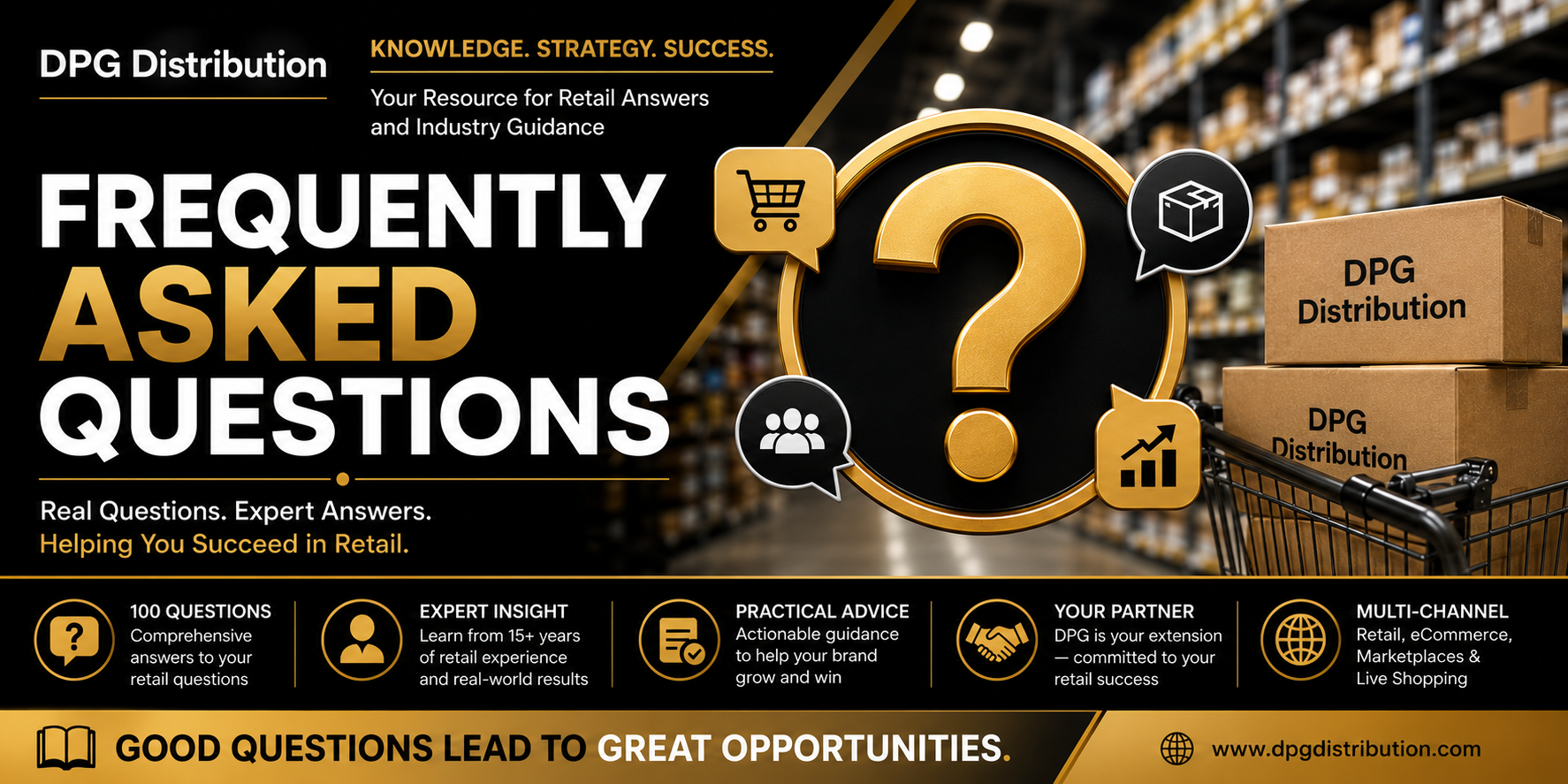
At DPG Distribution, we understand that preparing a product for retail can be a complex process. Manufacturers often have questions about retail readiness, pricing strategies, packaging requirements, GS1 UPC barcodes, EDI capabilities, inventory planning, retail compliance, and what it takes to successfully present products to major retailers. Our Frequently Asked Questions section is designed to provide clear, practical answers based on decades of real-world experience working with manufacturers, distributors, and retail buyers across multiple industries.
Whether you’re launching a new product, expanding into national retail chains, entering online marketplaces, or exploring international opportunities, our goal is to help you make informed decisions. These FAQs cover many of the topics brands ask us every day, including how retail sales representatives work, what buyers expect during product presentations, how vendor onboarding works, and the key steps involved in becoming Retail Ready™. By understanding these fundamentals, you’ll be better prepared to navigate the retail industry with confidence.
Can’t find the answer you’re looking for? The DPG Distribution team is here to help. Contact us to discuss your products, business goals, and retail strategy. With decades of industry experience and a nationwide network of retail sales professionals, we’re committed to helping manufacturers understand the retail landscape and pursue long-term growth across in-store retail, e-commerce, marketplaces, and emerging sales channels.
1. What does a sales representative company do?
A sales representative company helps manufacturers sell their products to retailers, distributors, dealers, and online marketplaces. Instead of hiring an internal sales team, brands partner with an experienced sales agency like DPG Distribution to leverage established buyer relationships, present products to retailers, negotiate opportunities, and grow sales across multiple channels.
2. What is a manufacturer’s representative?
A manufacturer’s representative (often called a “rep agency”) is an independent sales organization that represents manufacturers on a commission basis. Rather than purchasing inventory, manufacturers’ representatives promote products, meet with retail buyers, develop new business opportunities, and earn commissions only when products are sold.
3. What percentage do sales representatives charge?
Commission rates vary depending on the industry, product category, and sales channel. In many retail industries, commissions typically range from 3% to 10% of net sales. At DPG Distribution, commission structures are discussed individually based on each manufacturer’s goals, product line, and target retailers.
4. How do retail sales commissions work?
Retail sales representatives earn commissions when products they represent are sold to approved retail accounts. Once the retailer purchases and pays for the products, the manufacturer pays the agreed-upon commission according to the sales representative agreement.
5. What retailers does DPG Distribution work with?
DPG Distribution works with a wide range of national retailers, regional chains, specialty retailers, distributors, dealer networks, buying groups, and online marketplaces across numerous product categories. Retail opportunities depend on your product category, pricing, inventory, and overall retail readiness.
6. Do I need inventory before approaching retailers?
Yes. Most major retailers expect manufacturers to have inventory available or a reliable production schedule before approving new products. Buyers want confidence that suppliers can fulfill purchase orders on time and maintain inventory as demand grows.
7. How long does it take to get products into major retailers?
Every retailer has a different buying cycle. Depending on the retailer, product category, seasonality, and buyer schedules, the sales process may take anywhere from a few months to over a year. Success depends on preparation, persistence, and presenting a retail-ready product.
8. Do I need liability insurance?
In most cases, yes. Major retailers typically require manufacturers to carry product liability insurance before becoming an approved vendor. Insurance protects both the manufacturer and the retailer in the event of product-related claims.
9. What is Retail Ready™?
Retail Ready™ is DPG Distribution’s process for helping manufacturers prepare their products for retail success. It covers essential areas such as packaging, UPC barcodes, GS1 registration, pricing strategy, product specifications, marketing assets, logistics, inventory planning, EDI capabilities, compliance, and buyer presentations.
10. What is EDI?
EDI (Electronic Data Interchange) is the electronic exchange of business documents between retailers and suppliers. Purchase orders, invoices, shipping notices, inventory updates, and payment information are transmitted electronically, allowing retailers and vendors to communicate quickly and accurately.
11. Does DPG Distribution help brands sell on Amazon?
Yes. DPG works with brands interested in expanding into Amazon and other online marketplaces as part of a broader omnichannel retail strategy. Marketplace opportunities depend on the product category, pricing strategy, inventory availability, and overall business objectives.
12. Can DPG help international companies enter the U.S. market?
Yes. DPG Distribution works with manufacturers from around the world that want to sell into the United States. International companies often need assistance with import logistics, retail readiness, compliance, pricing strategy, packaging, inventory planning, and introductions to U.S. retailers.
13. What products does DPG Distribution represent?
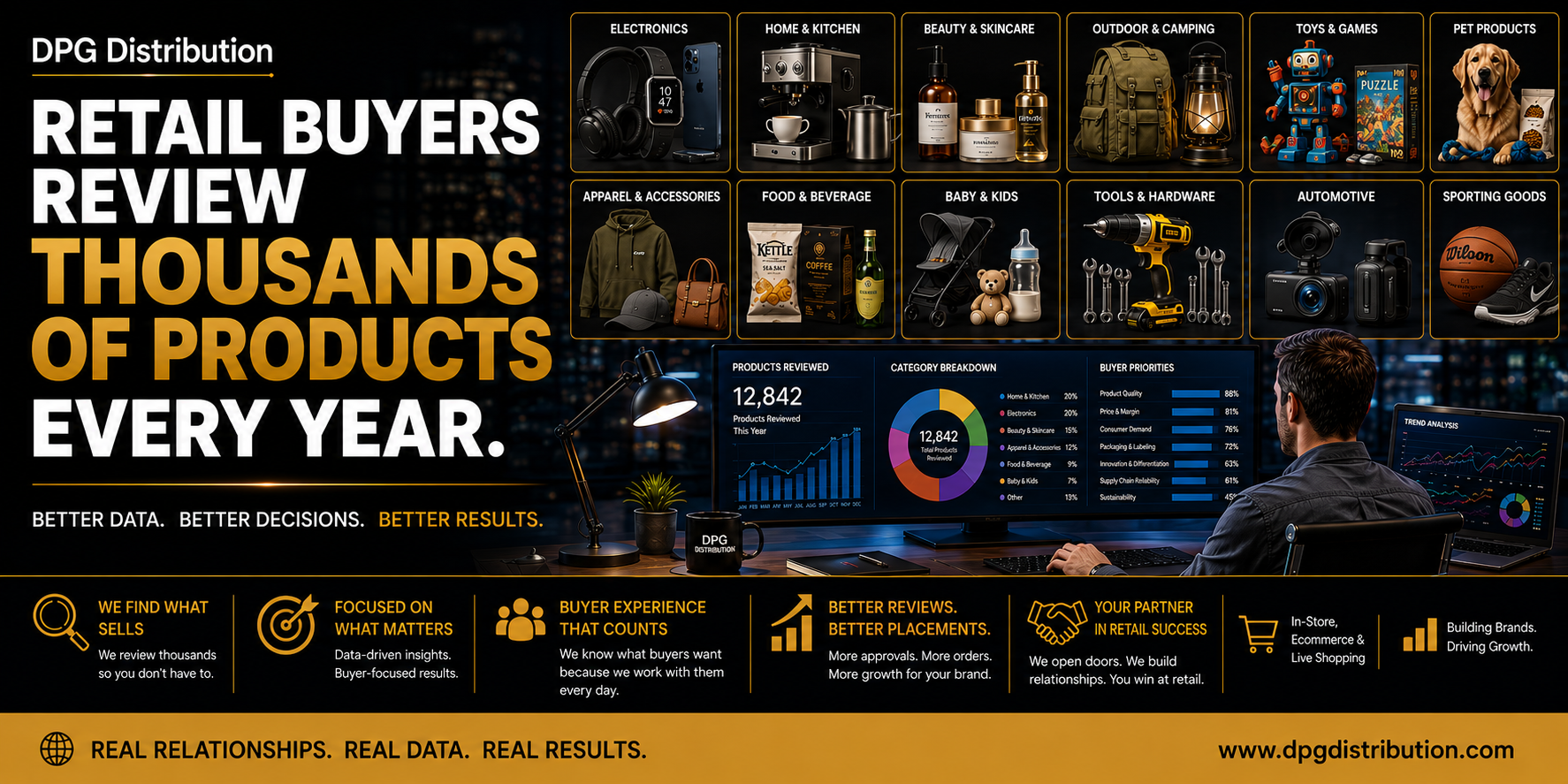
DPG represents a wide variety of consumer products, including consumer electronics, hardware, home improvement, sporting goods, automotive accessories, pet products, furniture, office products, health and beauty, lighting, toys, outdoor products, housewares, and many other retail categories.
14. How does DPG choose the brands it represents?
DPG carefully evaluates every opportunity based on product quality, market demand, pricing, inventory availability, operational readiness, and long-term partnership potential. Because DPG receives hundreds of inquiries each month, only a select number of brands are accepted.
15. Do you guarantee placement with retailers?
No. No reputable sales representative agency can guarantee retail placement. Retail buyers make their own purchasing decisions based on product quality, pricing, margins, consumer demand, category needs, and timing. DPG’s role is to professionally represent your brand, create opportunities, and maximize your chances of success.
16. What makes DPG Distribution different from other sales agencies?
Since 2011, DPG Distribution has built an extensive retail network across multiple sales channels. Rather than simply making introductions, DPG works as an extension of your sales team by helping manufacturers become retail ready, develop professional sales materials, prepare for buyer meetings, and manage opportunities throughout the sales process.
17. Can startups work with DPG Distribution?
Yes, provided the company is retail ready. Startups should have finished products, professional packaging, UPC barcodes, inventory planning, competitive pricing, marketing materials, and the operational ability to fulfill retailer purchase orders.
18. What is the difference between a distributor and a sales representative?
A distributor purchases inventory from manufacturers and resells it to retailers or dealers. A manufacturer’s sales representative does not purchase inventory. Instead, they represent the manufacturer, develop business opportunities, and earn commissions based on successful sales.
19. What is omnichannel retail?
Omnichannel retail is the integration of multiple sales channels—including physical stores, e-commerce, online marketplaces, social commerce, and live shopping—to provide customers with a seamless shopping experience regardless of where they choose to buy.
20. How can I determine if my product is retail ready?
A retail-ready product typically has professional packaging, GS1-issued UPC barcodes, competitive pricing, reliable inventory, product liability insurance, product specification sheets, marketing assets, compliance documentation, and the operational capability to support retailer requirements. DPG’s Retail Ready™ program helps manufacturers evaluate and strengthen each of these areas before approaching retail buyers.
21. What is the difference between wholesale and retail?
Wholesale involves selling products in bulk to businesses such as retailers or distributors, while retail involves selling products directly to consumers. Manufacturers typically sell wholesale, allowing retailers to resell products at a profit.
22. Do I need a UPC barcode before selling to retailers?
Yes. Most major retailers require GS1-issued UPC barcodes so products can be scanned, tracked, and managed throughout their inventory systems.
23. What is GS1?
GS1 is the global organization responsible for issuing authentic UPC barcodes and GTINs used by retailers worldwide. Most major retailers require GS1-registered barcodes before accepting new products.
24. What is a product specification sheet?
A product specification sheet provides buyers with technical information including dimensions, weight, materials, certifications, packaging, UPC codes, country of origin, and product features.
25. What is a sell sheet?
A sell sheet is a professional one- or two-page sales document that highlights your product’s features, benefits, pricing, and competitive advantages for retail buyers.
26. What is a retail line review?
A line review is a formal meeting where manufacturers present products to retail buyers for consideration. Buyers evaluate pricing, margins, packaging, inventory, consumer demand, and category fit before making purchasing decisions.
27. What is vendor onboarding?
Vendor onboarding is the approval process retailers use before allowing manufacturers to sell products. It often includes contracts, insurance, banking information, EDI setup, compliance documentation, and product data.
28. What is a purchase order (PO)?
A purchase order is an official document issued by a retailer authorizing the purchase of products. It specifies quantities, pricing, delivery dates, shipping instructions, and payment terms.
29. What is a planogram?
A planogram is a detailed diagram that shows where products should be placed on retail shelves to maximize visibility, organization, and sales performance.
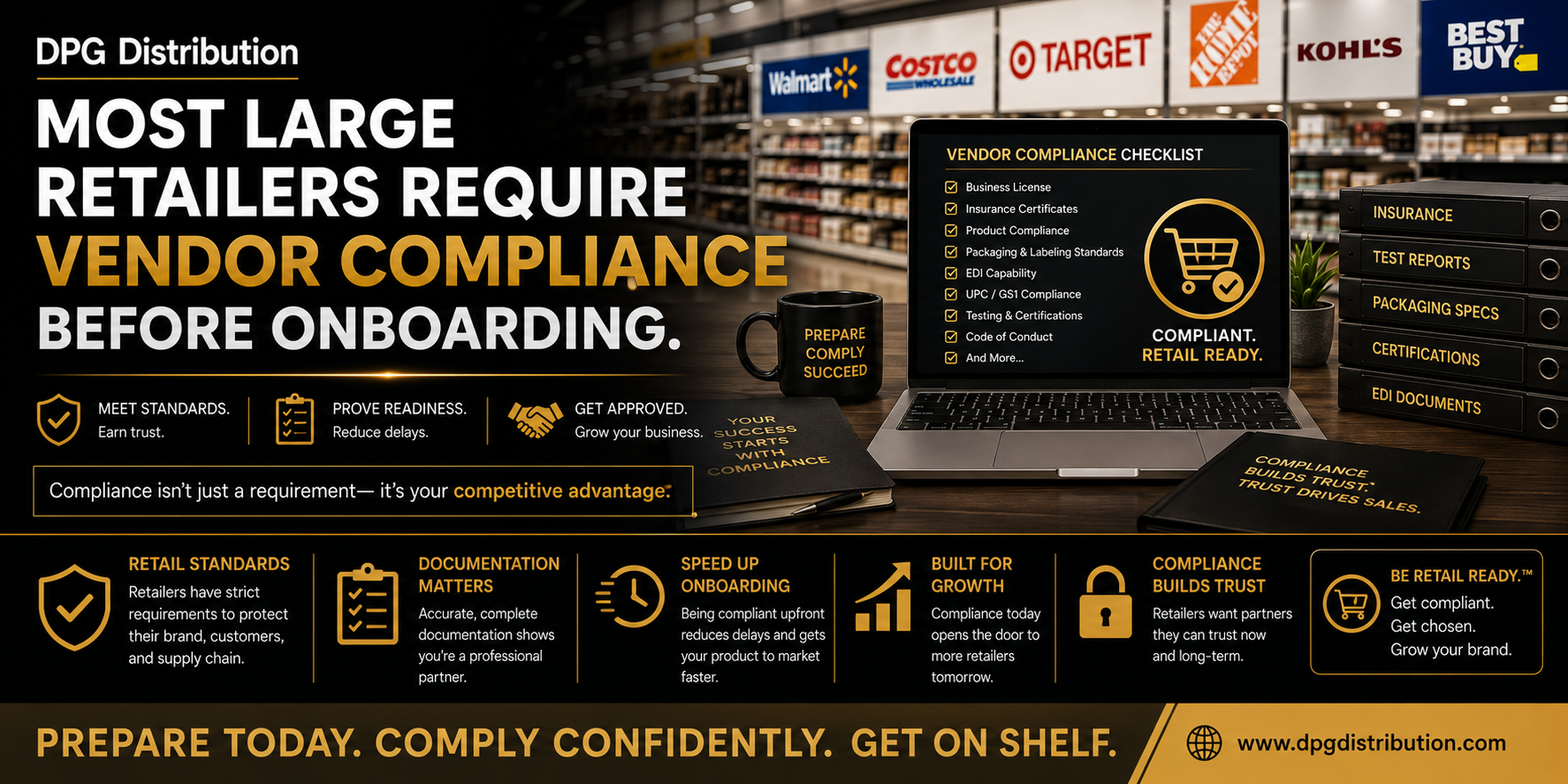
30. What is vendor compliance?
Vendor compliance refers to the operational standards suppliers must meet regarding packaging, labeling, shipping, delivery schedules, EDI, and documentation. Non-compliance may result in retailer chargebacks.
31. What are retailer chargebacks?
Chargebacks are financial penalties assessed when suppliers fail to meet retailer requirements such as incorrect labeling, late shipments, damaged packaging, or missing EDI documents.
32. What is OTIF?
OTIF stands for On Time In Full. It measures whether suppliers deliver complete orders by the required delivery date. Many retailers closely monitor OTIF performance.
33. What is MOQ?
MOQ, or Minimum Order Quantity, is the smallest quantity a manufacturer will produce or sell in a single order.
34. What is MAP pricing?
Minimum Advertised Price (MAP) is the lowest price retailers are allowed to advertise a product. MAP policies help protect brand value and maintain pricing consistency across sales channels.
35. What is MSRP?
Manufacturer’s Suggested Retail Price (MSRP) is the retail price recommended by the manufacturer. Retailers generally have discretion to determine their final selling price unless otherwise restricted by law.
36. Can DPG help with product packaging?
Yes. Packaging plays a critical role in retail success. DPG helps brands understand retail packaging expectations and prepare products that meet retailer requirements and appeal to consumers.
37. Does DPG help prepare sales presentations?
Yes. DPG works with manufacturers to develop professional sales decks, sell sheets, product specification sheets, and other marketing materials used during buyer presentations.
38. Does DPG work with startups?
Yes. DPG works with startups that have retail-ready products, adequate inventory, professional packaging, competitive pricing, and the operational capability to support retail growth.
39. Does DPG work with established brands?
Absolutely. DPG represents both emerging companies and established manufacturers seeking to expand into new retailers, sales channels, marketplaces, or geographic markets.
40. Can DPG help launch new products?
Yes. DPG assists manufacturers with retail launch strategies, buyer presentations, pricing recommendations, merchandising support, and retail expansion planning.
41. Does DPG work with distributors?
Yes. Depending on the product category and market strategy, DPG may help manufacturers develop relationships with qualified distributors in addition to retailers.
42. Can DPG help with international expansion?
Yes. DPG works with companies interested in expanding into U.S. retail and can also assist with strategies for selected international markets through its network and partnerships.
43. How important is inventory planning?
Inventory planning is essential. Retailers expect suppliers to fulfill purchase orders on time and maintain inventory to support ongoing sales. Poor inventory planning can damage retailer relationships and result in lost business.
44. Why is pricing strategy important?
Retail pricing affects retailer margins, consumer demand, competitive positioning, and profitability. A well-planned pricing strategy increases the likelihood of retail acceptance and long-term success.
45. What industries does DPG specialize in?
DPG represents brands across numerous industries, including consumer electronics, hardware, automotive, sporting goods, pet products, home improvement, furniture, office products, health and beauty, housewares, lighting, toys, and outdoor products.
46. Does DPG attend trade shows?
Yes. Trade shows provide valuable opportunities to meet buyers, discover new products, strengthen retailer relationships, and introduce manufacturers to potential customers.
47. What makes a product attractive to retail buyers?
Retail buyers evaluate products based on consumer demand, innovation, pricing, profit margins, packaging, inventory availability, product quality, marketing support, and the manufacturer’s ability to execute consistently.
48. How can I improve my chances of getting into retail?
Prepare your business before approaching buyers. Professional packaging, competitive pricing, GS1 UPC barcodes, inventory readiness, marketing materials, compliance documentation, and a clear value proposition all improve your chances of success.
49. Why should I work with DPG Distribution?
DPG Distribution serves as an extension of your sales team by helping manufacturers prepare for retail, develop sales strategies, present products to buyers, and pursue growth opportunities across multiple retail channels.
50. How do I get started with DPG Distribution?
The first step is to contact DPG Distribution to discuss your products, target retailers, business goals, and current level of retail readiness. From there, DPG can determine whether there is a good fit and recommend the next steps for pursuing retail opportunities.
51. What is retail distribution?
Retail distribution is the process of moving products from manufacturers to retailers through direct sales, distributors, wholesalers, or dealer networks so consumers can purchase them.
52. What is a distribution center (DC)?
A distribution center is a warehouse where retailers receive, store, sort, and ship inventory to individual stores or directly to customers.
53. What is cross-docking?
Cross-docking is a logistics process where products move directly from incoming trucks to outgoing trucks with little or no warehouse storage, improving speed and reducing costs.
54. What is a master carton?
A master carton is the outer shipping box that contains multiple retail units. It protects products during shipping and must often meet retailer packaging specifications.
55. What is pallet configuration?
Pallet configuration refers to how master cartons are stacked on a pallet to maximize shipping efficiency and comply with retailer requirements.
56. Why is retail packaging so important?
Retail packaging protects products, communicates your brand, attracts customers, and must meet retailer requirements for shipping, merchandising, and shelf presentation.
57. What makes packaging retail ready?
Retail-ready packaging includes professional graphics, GS1 UPC barcodes, proper labeling, durable construction, compliance information, and packaging that fits retailer merchandising requirements.
58. Why do retailers require GS1 barcodes?
GS1-issued UPC barcodes provide globally unique product identification that allows retailers to accurately track inventory, pricing, and sales.
59. Can I use barcode generators instead of GS1?
Many major retailers require authentic GS1-issued UPC barcodes. While other barcode services exist, GS1 remains the industry standard.
60. What is a GTIN?
A Global Trade Item Number (GTIN) is the unique product identifier issued by GS1 and used by retailers worldwide.
61. What is inventory turnover?
Inventory turnover measures how quickly products sell and are replenished. Higher turnover generally indicates strong product demand.
62. Why do retailers care about inventory turnover?
Products that sell quickly generate more revenue per square foot of shelf space, making them more attractive to retailers.
63. What is an end cap?
An end cap is a display located at the end of a retail aisle. Because it receives heavy customer traffic, it is one of the most valuable merchandising locations in a store.
64. What is point-of-purchase (POP) advertising?
POP advertising includes displays, signs, and promotional materials placed near products to encourage impulse purchases.
65. What is merchandising?
Merchandising is the strategic placement, pricing, presentation, and promotion of products to increase sales.
66. Why is shelf placement important?
Products placed at eye level or in premium locations generally receive more customer attention and higher sales.
67. What is a retail reset?
A retail reset is when a retailer reorganizes shelves, replaces products, or updates planograms to improve merchandising.
68. What is category management?
Category management is the practice of managing an entire product category as a business unit to maximize sales and profitability.
69. What is a category captain?
A category captain is a manufacturer selected by a retailer to provide insights and recommendations for improving an entire product category.
70. What is assortment planning?
Assortment planning determines which products, colors, sizes, and variations a retailer should stock to meet customer demand.
71. What is demand planning?
Demand planning uses sales history and market trends to forecast future inventory needs.
72. Why is forecasting important?
Accurate forecasting helps manufacturers maintain inventory, avoid stockouts, and meet retailer demand.
73. What is lead time?
Lead time is the total time required to manufacture, ship, and deliver products after an order is placed.
74. Why do buyers ask about lead times?
Retailers need confidence that suppliers can replenish inventory quickly and consistently.
75. What is a fill rate?
Fill rate measures the percentage of orders shipped completely and on time.
76. What is first cost?
First cost is the price a retailer pays the manufacturer before freight and additional expenses are added.
77. What is FOB?
FOB (Free on Board) defines when ownership and responsibility for goods transfer from the seller to the buyer during shipping.
78. What is freight collect?
Freight collect means the buyer pays shipping charges.
79. What is freight prepaid?
Freight prepaid means the seller pays shipping charges.
80. What is a buying group?
A buying group combines the purchasing power of multiple independent retailers to negotiate better pricing and supplier terms.
81. What is a buying office?
A buying office is the department responsible for selecting merchandise and managing supplier relationships.
82. What is a key account?
A key account is a strategically important customer that generates significant sales volume.
83. What is a key account manager?
A key account manager oversees relationships with major retailers and develops long-term growth strategies.
84. What is a dealer network?
A dealer network is a group of authorized businesses that sell and support a manufacturer’s products.
85. What is direct store delivery (DSD)?
DSD is a distribution model where products are delivered directly to individual retail stores instead of a distribution center.
86. What is drop shipping?
Drop shipping is an order fulfillment method where products are shipped directly from the supplier to the customer.
87. What is omnichannel retail?
Omnichannel retail integrates physical stores, e-commerce, marketplaces, mobile apps, and social commerce into one customer experience.
88. What is multi-channel retail?
Multi-channel retail sells products through multiple independent sales channels, such as stores, distributors, and marketplaces.
89. What is e-commerce?
E-commerce is the buying and selling of products through websites, online marketplaces, and digital platforms.
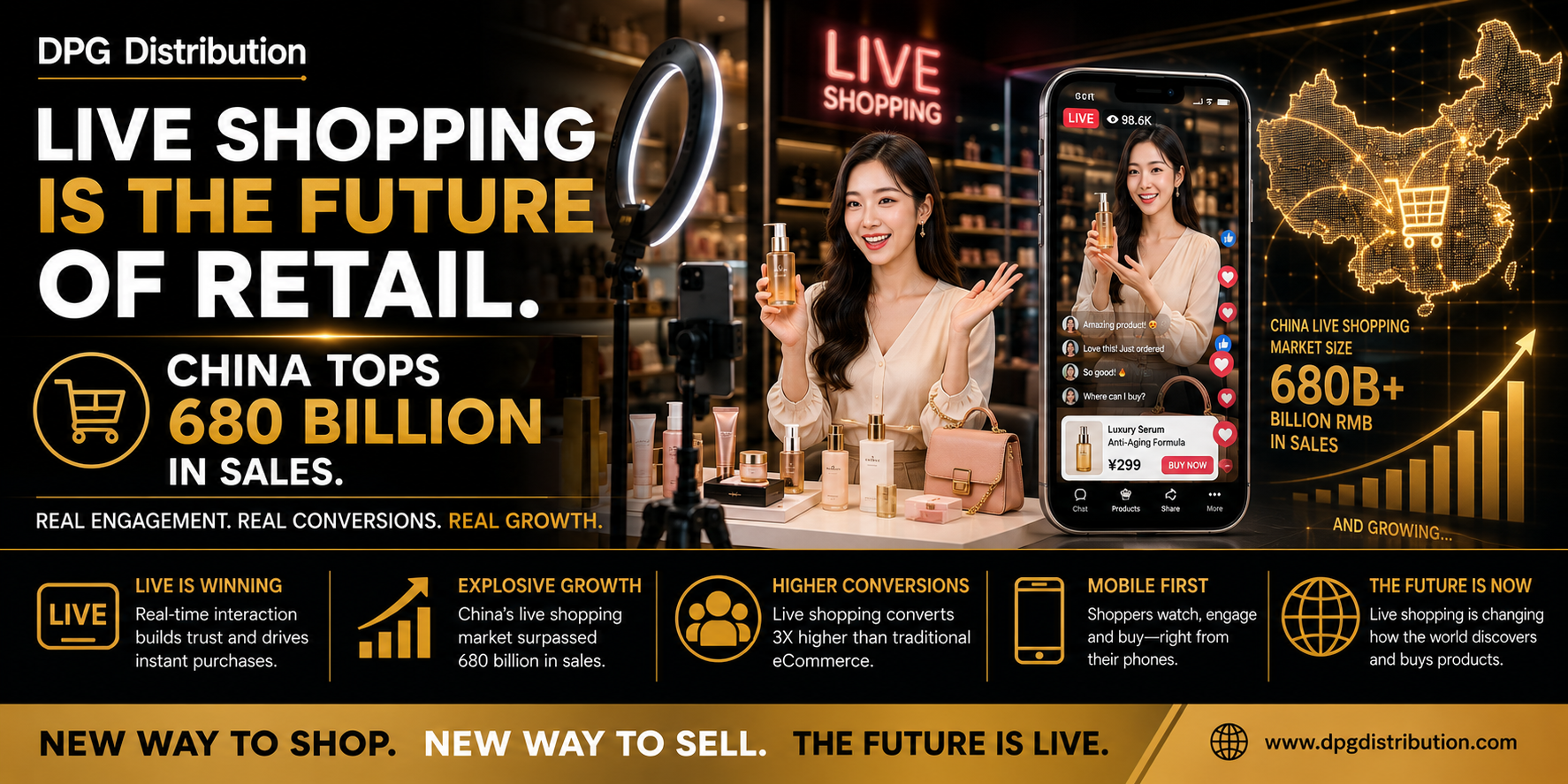
90. What is live shopping?
Live shopping combines live video demonstrations with online purchasing, allowing consumers to buy products while watching product presentations.
91. Why do retailers require EDI?
EDI improves speed, accuracy, and efficiency by electronically exchanging purchase orders, invoices, shipping notices, and inventory information.
92. What is vendor managed inventory (VMI)?
VMI allows suppliers to monitor retailer inventory levels and replenish stock as needed.
93. What is a vendor number?
A vendor number is a unique identification number assigned by a retailer to an approved supplier.
94. Why do retailers have vendor agreements?
Vendor agreements establish pricing, payment terms, compliance requirements, shipping standards, and legal responsibilities.
95. What is quality assurance (QA)?
Quality assurance ensures products consistently meet manufacturing, safety, and performance standards.
96. What is hazardous materials compliance?
Hazardous materials compliance ensures products containing regulated materials meet transportation, labeling, and safety regulations.
97. What is third-party logistics (3PL)?
A 3PL provider offers outsourced warehousing, fulfillment, shipping, and logistics services for manufacturers and retailers.
98. What is retail profitability?
Retail profitability measures how much profit a manufacturer or retailer earns after accounting for product costs, freight, marketing, and operating expenses.
99. Why is retail readiness so important?
Retail readiness demonstrates that a manufacturer is prepared to meet retailer expectations regarding packaging, pricing, inventory, logistics, compliance, and operational capabilities. Brands that are retail ready are generally better positioned to secure buyer meetings and successfully fulfill purchase orders.
100. What is the first step toward getting my product into retail stores?
The first step is evaluating whether your business is truly retail ready. Manufacturers should assess packaging, pricing, UPC barcodes, inventory, logistics, marketing materials, compliance, and operational capabilities before approaching retailers. Working with an experienced sales representative agency like DPG Distribution can help identify strengths, address gaps, and improve your chances of retail success.
Written by George W. Davison, Founder & CEO of DPG Distribution | 34+ Years of Retail Industry Experience.
Company Information
DBA DPG Distribution
1515 International Pkwy, Suite 2019
Heathrow, Florida 32746
Quick Links
Telephone
Email Us
